WordPress is still the most reliable website platform for businesses because it combines flexibility, ownership and scalability in a way most modern builders cannot. For new business owners, it provides a foundation that works both now and as the business grows.
Introduction
Choosing a website builder has become increasingly confusing. New platforms promise faster setup, simpler design and fewer technical decisions, which can be appealing when launching a new business.
However, many of these platforms prioritise ease of use at the expense of flexibility and long-term control. WordPress continues to stand out because it solves problems that appear later, not just on day one. Understanding why helps business owners make a decision they are less likely to regret.
Key Takeaways
- WordPress offers flexible design without compromising speed or responsiveness.
- Websites can be built efficiently without limiting future growth.
- Full ownership prevents platform lock-in and unexpected restrictions.
- The platform scales naturally as business needs evolve.
- WordPress integrates easily with modern business tools.
Reason 1: Flexible Builders Without Sacrificing Performance
WordPress has changed significantly over the past few years. Modern builders now allow businesses to create custom, responsive websites without relying on rigid templates or heavy custom development.
Flexible layouts that adapt to your business
WordPress builders make it easy to design layouts that match how a business actually operates. Pages can be structured around services, conversion paths and user behaviour rather than being forced into pre-defined formats.
This flexibility becomes especially useful when offerings change or expand.
Performance is easier to manage and troubleshoot
Unlike many closed platforms, WordPress allows full visibility into how a site is built and rendered. This makes it easier to identify and fix performance issues rather than working around platform limitations.
Breakpoint – Practical insight:
Flexibility matters most when a business needs to adjust quickly, not when everything is going perfectly.
Reason 2: Faster to Build Than Most People Expect
WordPress is often assumed to be slower to develop, but this is rarely true in practice.
A mature ecosystem saves development time
Because WordPress has been around for so long, many common requirements already have reliable solutions. This reduces the need to build features from scratch and speeds up delivery.
Typical features that can be implemented quickly include:
- Contact and enquiry forms
- Blogs and content sections
- Analytics and tracking
- Basic automation and integrations
Faster now also means fewer rebuilds later
Quick-launch platforms often feel fast at the start but require rebuilding once limitations appear. WordPress reduces this risk by supporting future expansion from the beginning.
Reason 3: Full Ownership and Control
Ownership is one of the most overlooked aspects when choosing a website platform.
You control your website and your data
With WordPress, the website belongs entirely to the business. Content, data and structure are not tied to a single provider’s pricing or product decisions.
This allows businesses to:
- Change hosting providers
- Modify functionality freely
- Avoid sudden pricing changes
Avoiding long-term platform lock-in
Closed platforms can become restrictive as needs grow. WordPress makes it easier to adapt or move without losing access to your own assets.
Breakpoint – Common issue:
Many businesses only realise the cost of lock-in once switching platforms becomes difficult or expensive.
Reason 4: It Scales With Your Business
WordPress is not just suitable for small websites. It supports gradual growth without forcing major changes.
Start simple without limiting future options
A WordPress site can begin as a basic online presence and later evolve into a more complex system. New features can be added as needed rather than all at once.
Common additions over time include:
- Blogs and content libraries
- Booking and payment systems
- CRM and email integrations
- Automation and tracking tools
Scaling without disruption
Because WordPress is modular, businesses can add functionality without redesigning or rebuilding the entire site. This makes scaling smoother and less disruptive.
Reason 5: It Plays Well With Everything
Modern businesses rely on multiple tools to operate efficiently, and websites rarely exist in isolation.
Easy integration with business tools
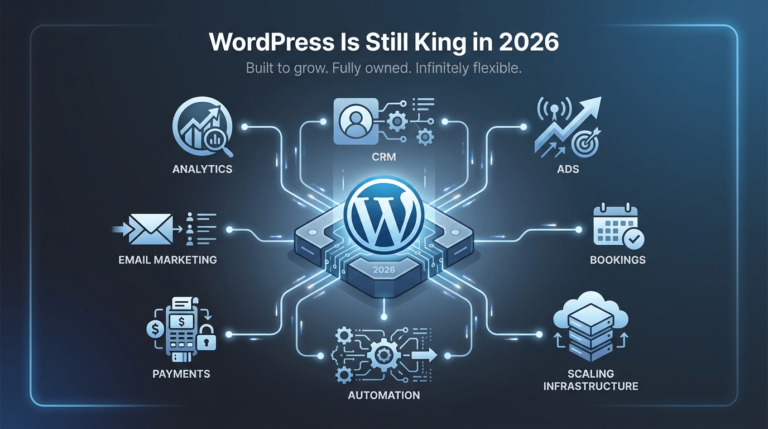
WordPress integrates well with analytics platforms, CRMs, advertising systems, email marketing tools and booking software. This allows businesses to create connected workflows rather than disconnected systems.
Better visibility and decision-making
When tools work together, it becomes easier to track performance, automate tasks and understand what is actually driving results.
Breakpoint – Real-world benefit:
A website that connects properly to business systems becomes a working asset, not just an online brochure.
Conclusion: Why It Still Matters
WordPress may not be the newest website builder, but it remains one of the most practical choices for businesses that want control and flexibility.
For new business owners, the ability to launch quickly, scale naturally and integrate with essential tools makes WordPress a reliable long-term foundation. Choosing a platform that supports growth rather than limiting it can save significant time and effort later on.