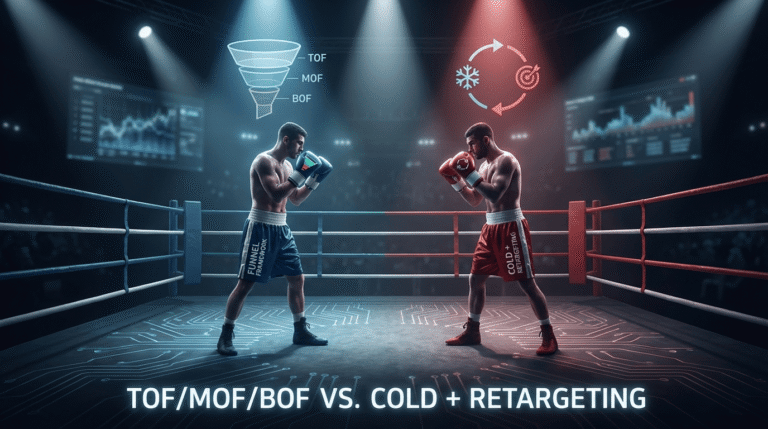
TOF/MOF/BOF vs Cold + Retargeting Explained Properly
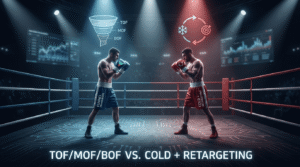
There are two dominant schools of thought in Meta ads today.
One follows a traditional top-of-funnel, middle-of-funnel and bottom-of-funnel structure.
The other ignores funnels almost entirely and runs only cold and retargeting campaigns.
This article explains how Meta actually works in 2026, the strengths and weaknesses of both approaches, and why many high-performing accounts use both at different stages.
If you want clarity on which Meta ads framework fits your business, this guide will help you decide without guessing.
Introduction: Why Meta Ads Frameworks Are So Confusing
Spend enough time around Meta ads advice and you’ll notice something strange.
Everyone sounds confident, yet everyone disagrees.
Some marketers insist that TOF, MOF and BOF campaigns are essential. Others, including very experienced Meta buyers, say they only ever run cold traffic and retargeting. Both approaches produce results. Both camps claim the other is wrong.
The confusion comes from misunderstanding what Meta actually optimises for. Once you understand that, the debate becomes far less polarised and far more practical.
How Meta Actually Thinks About Users
Meta does not think in funnel stages.
It never has.
Meta’s algorithm optimises for probability. Specifically, the probability that a given person will take the action you are optimising for at that moment.
It looks at:
- Past behaviour
- Similar user patterns
- Engagement signals
- Time-to-action likelihood
- Conversion history
When people say “Meta knows where someone is in the funnel”, what they really mean is that Meta is estimating how likely that person is to convert right now.
Key takeaway: Meta optimises for likelihood of action, not theoretical funnel position.
The Traditional TOF / MOF / BOF Framework
How This Framework Works
This approach assumes people move through stages:
- Top of funnel builds awareness and initial interest
- Middle of funnel builds trust and consideration
- Bottom of funnel pushes for conversion
Each stage has its own campaign structure, messaging and optimisation goal.
Advantages of TOF / MOF / BOF
This framework remains popular for good reasons.
It is easy to explain to clients and stakeholders.
It creates a clear structure inside ad accounts.
It works well for complex offers and longer decision cycles.
It allows messaging to be sequenced intentionally.
For many businesses, especially early on, this structure brings clarity.
Disadvantages of TOF / MOF / BOF
The downside is that it assumes behaviour is linear.
In reality, it rarely is.
Some people convert on their first interaction.
Others see bottom-of-funnel ads before awareness content.
Artificial separation can slow optimisation and increase complexity.
Funnels often look better in presentations than they do in real performance data.
Key takeaway: Funnels create order, but user behaviour rarely follows neat paths.
The Cold + Retargeting Framework
How This Framework Works
This approach simplifies everything into two groups:
- Cold audiences with no meaningful interaction yet
- Retargeting audiences who have shown intent or familiarity
Instead of forcing stages, it relies on Meta to identify buyers within cold traffic and uses retargeting to capture delayed decisions.
Advantages of Cold + Retargeting
This framework leans directly into Meta’s strengths.
It simplifies account structure.
It speeds up learning and optimisation.
It gives clearer budget control.
It often produces faster feedback loops.
When creatives are strong and the offer is clear, Meta is extremely good at finding buyers inside cold audiences.
Disadvantages of Cold + Retargeting
This simplicity comes at a cost.
It relies heavily on creative quality.
It provides less control over narrative sequencing.
It can be harder to explain to less experienced clients.
It struggles if retargeting pools are weak or shallow.
Without strong messaging, cold traffic will simply burn budget.
Key takeaway: Cold + retargeting is powerful, but unforgiving.
Why the Debate Is Framed Wrong
The real question is not:
- TOF vs MOF vs BOF
- Funnel vs no funnel
The real distinction is:
- Structure-led buying vs creative-led buying
Meta rewards:
- Clear relevance signals
- Creatives that self-qualify the user
- High-quality conversion events
- Ads that reduce ambiguity
If your creative does this well, Meta does not need rigid funnel stages to infer intent.
Why Funnels Are Excellent for Learning the Market
This is where TOF / MOF / BOF is often misunderstood.
Even when funnels are not the most efficient long-term execution model, they are extremely valuable as a learning system.
By separating traffic into stages, you can clearly see:
- Which messages work before trust exists
- Which objections matter mid-decision
- What actually pushes people to convert
- How long the real decision cycle is
- Where drop-off genuinely occurs
This is market research, not just advertising.
Examples of insights funnels reveal:
- Strong TOF engagement but weak MOF movement suggests interest without trust
- MOF clicks without BOF conversions often signal offer or CTA mismatch
- BOF underperformance despite traffic can indicate overestimated intent
- Different creatives winning at different stages expose messaging hierarchy
Key takeaway: Funnels are powerful for learning how your market thinks.
Why Many Teams Then Simplify to Cold + Retargeting
Once those insights are clear, the account no longer needs heavy structure.
At that point:
- Cold traffic can carry mixed intent effectively
- Meta can optimise across richer behavioural signals
- Retargeting becomes a safety net, not a crutch
- Budget efficiency improves
- Complexity drops
In simple terms, funnels help you learn.
Cold + retargeting helps you exploit what you’ve learned.
Key takeaway: Funnels teach you the market, simplified structures help you scale.
When TOF / MOF / BOF Makes Sense
This framework performs best when:
- The offer is complex
- The buying cycle is long
- Education is required before trust
- Budgets are large enough to support multiple stages
Common examples include enterprise SaaS, regulated industries and high-ticket B2B decisions.
Expected outcomes include higher initial CPL, slower learning and more predictable scaling once optimised.
When Cold + Retargeting Works Better
This framework excels when:
- The offer is easy to understand
- Visuals do most of the selling
- Buying intent already exists
- Speed and efficiency matter
This is common in real estate, local services and lead generation funnels.
Expected outcomes include faster optimisation, lower initial CPL, higher volatility and greater reliance on creative quality.
The Flow Digital View: Frameworks Don’t Convert, Systems Do
At Flow Digital, frameworks are tools, not rules.
You don’t choose a Meta ads framework first.
You choose:
- The offer
- The buying context
- The audience’s urgency
- The creative angle
Only then do you decide how much structure is needed and how much freedom you give Meta to optimise.
Rigid frameworks fail when they ignore context.
Flexible systems win when they reflect real behaviour.
Conclusion: Stop Arguing About Frameworks
Both approaches work.
Both approaches fail when applied blindly.
TOF / MOF / BOF is often best used to understand a market.
Cold + retargeting is often best used to scale what you’ve learned.
Meta ads performance doesn’t come from choosing sides.
It comes from aligning creative, offer, optimisation and expectations.
If you’re unsure which approach fits your business, the fastest way forward is auditing how your current system aligns with real user behaviour.