Summary
Most Meta ads fail because they try to be creative instead of clear. High-converting ads follow a simple, repeatable structure that prioritises relevance, focus and intent. In this guide, we break down exactly how Meta ads work, format by format, and how each component contributes to lead generation. This is not theory. It’s anatomy.
If you want to audit your own Meta ads using a proven framework, this article will show you exactly what to look for.
Introduction: Why Most Meta Ads Don’t Convert
Meta ads don’t fail because of bad design.
They fail because they don’t answer the right questions fast enough.
When someone scrolls through Instagram or Facebook, you have roughly one second to signal relevance. If that moment is missed, nothing else matters. Not the copy. Not the offer. Not the targeting.
This article breaks Meta ads down into their functional parts. Not from a creative perspective, but from a decision-making one. By the end, you’ll understand how high-performing ads are structured, why certain formats work better in specific situations, and how to design ads that consistently turn attention into leads.
The Three Meta Ad Formats (And When Each One Works Best)
Before looking at anatomy, you need to understand format. Different formats solve different problems.
Video Ads: Best for Attention and Emotional Buy-In
Video ads are the most effective format for cold audiences and high-consideration offers. Motion interrupts scrolling behaviour and allows you to communicate more context in less time.
The real advantage of video is not storytelling. It’s speed. You can show location, price, emotion and credibility almost instantly. That’s why video performs particularly well for real estate, services and anything where trust or aspiration plays a role.
Key takeaway: Video ads work best when relevance is communicated in the first second, not after an introduction.
Carousel Ads: Best for Clarity and Comparison
Carousel ads give you space. They allow users to explore instead of decide immediately. This makes them ideal for multiple listings, comparisons, objection handling or mid-funnel education.
There are two effective carousel styles. The first is listing-based, where each slide presents a specific option. The second is story-based, where each slide progresses a single idea, such as a concern followed by an explanation and then a solution.
Key takeaway: Carousels convert when each slide has a single purpose and the sequence feels intentional.
Static Image Ads: Best for Simplicity and Retargeting
Static ads still work extremely well when the message is clear and the audience already has context. They are fast to process and easy to repeat, which makes them ideal for retargeting and high-frequency campaigns.
The mistake most people make with static ads is trying to do too much. A strong static ad answers three questions quickly and gets out of the way.
Key takeaway: Static ads perform best when clarity beats creativity.
The Core Anatomy of a High-Converting Meta Ad
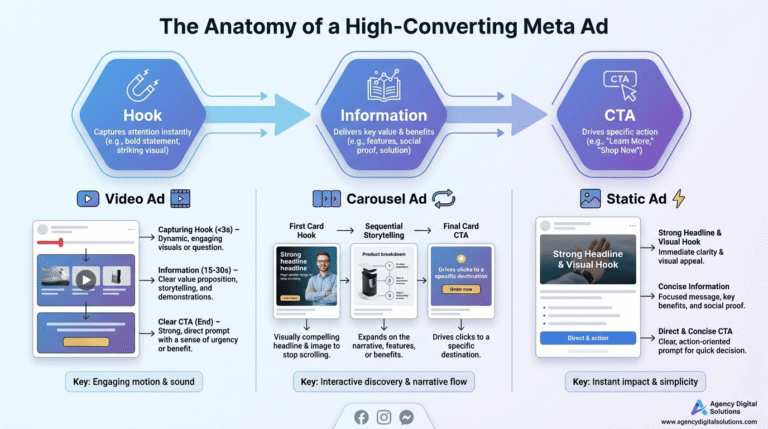
Every high-performing Meta ad, regardless of format, follows the same structure:
Hook → Information → CTA
This isn’t a creative preference. It mirrors how people make decisions while scrolling.
Video Ad Anatomy: Second-by-Second Breakdown
The Hook (0–1 second): Immediate Relevance
The hook exists for one reason only: to make the viewer recognise themselves.
This is where relevance must be obvious. In real estate, that often means stating the location and price immediately. For example, mentioning Bali or a specific region before one second has passed tells the right audience to keep watching and everyone else to move on.
Hooks can also be emotional, observational or lightly comedic, but relevance always comes first.
Key takeaway: If the viewer cannot tell the ad is for them instantly, the ad has already failed.
The Information Layer (1–10 seconds): Focused Clarity
Once attention is earned, the ad needs to justify the click. This does not mean explaining everything.
Strong video ads focus on a single pain point and reinforce it clearly. For some audiences, that might be legality. For others, lifestyle or security. The key is choosing one concern and addressing it properly instead of listing five weak benefits.
This is where trust starts forming.
Key takeaway: High-converting ads explain just enough to create curiosity, not confidence.
The CTA (Final Seconds): Removing Uncertainty
The CTA is not just a button. It’s a transition.
People hesitate when they don’t know what happens next. A good CTA explains the next step clearly. Whether someone will view listings, receive a brochure or be contacted by a team member, this should be stated plainly.
Vagueness kills conversion.
Key takeaway: Clear next steps outperform clever CTAs every time.
Carousel Ad Anatomy: Two Proven Structures
Listing-Style Carousel: Options First
This structure works well when showcasing multiple properties or offers. The first slide stops the scroll, the middle slides provide individual options, and the final slide focuses on action.
Text should be minimal, layouts consistent, and value obvious at a glance.
Key takeaway: Each slide should answer one question, not multiple.
Story-Style Carousel: Objection to Resolution
Story carousels are powerful when addressing hesitation. For example, starting with a concern about scams, then explaining how your process differs, and finishing with proof or reassurance.
This mirrors the internal dialogue many buyers already have.
Key takeaway: Carousels convert when they feel like a conversation, not a catalogue.
Static Ad Anatomy: The Three Questions Rule
Every static Meta ad must answer these three questions immediately:
Who are you
What do you offer
Why does it matter to me
If any of these are unclear, the ad becomes invisible. Branding alone is not enough. Generic messaging is ignored.
Key takeaway: If your static ad could belong to any business, it belongs to none.
The Elements Outside the Creative That Still Matter
Your creative does not exist in isolation. Primary text, headlines and CTA buttons all reinforce the message.
Primary text should support the hook, not repeat it. Headlines should restate value, not be clever. CTA buttons should match intent, not ambition.
This is where many ads quietly lose conversions.
Why Most Meta Ads Fail in Practice
Most Meta ads fail for predictable reasons. Too much information. No relevance signal. Vague CTAs. Assumptions instead of clarity.
These aren’t creative problems. They’re structural ones.
Conclusion: Meta Ads Are Systems, Not Art
High-converting Meta ads are not masterpieces.
They are structured decision paths designed for speed, relevance and clarity.
When format, hook, information and CTA work together, ads stop feeling intrusive and start feeling useful. That’s when lead generation becomes consistent.
If you want a second set of eyes on your Meta ads or want to understand why traffic isn’t converting, reviewing them through this framework is the fastest place to start.